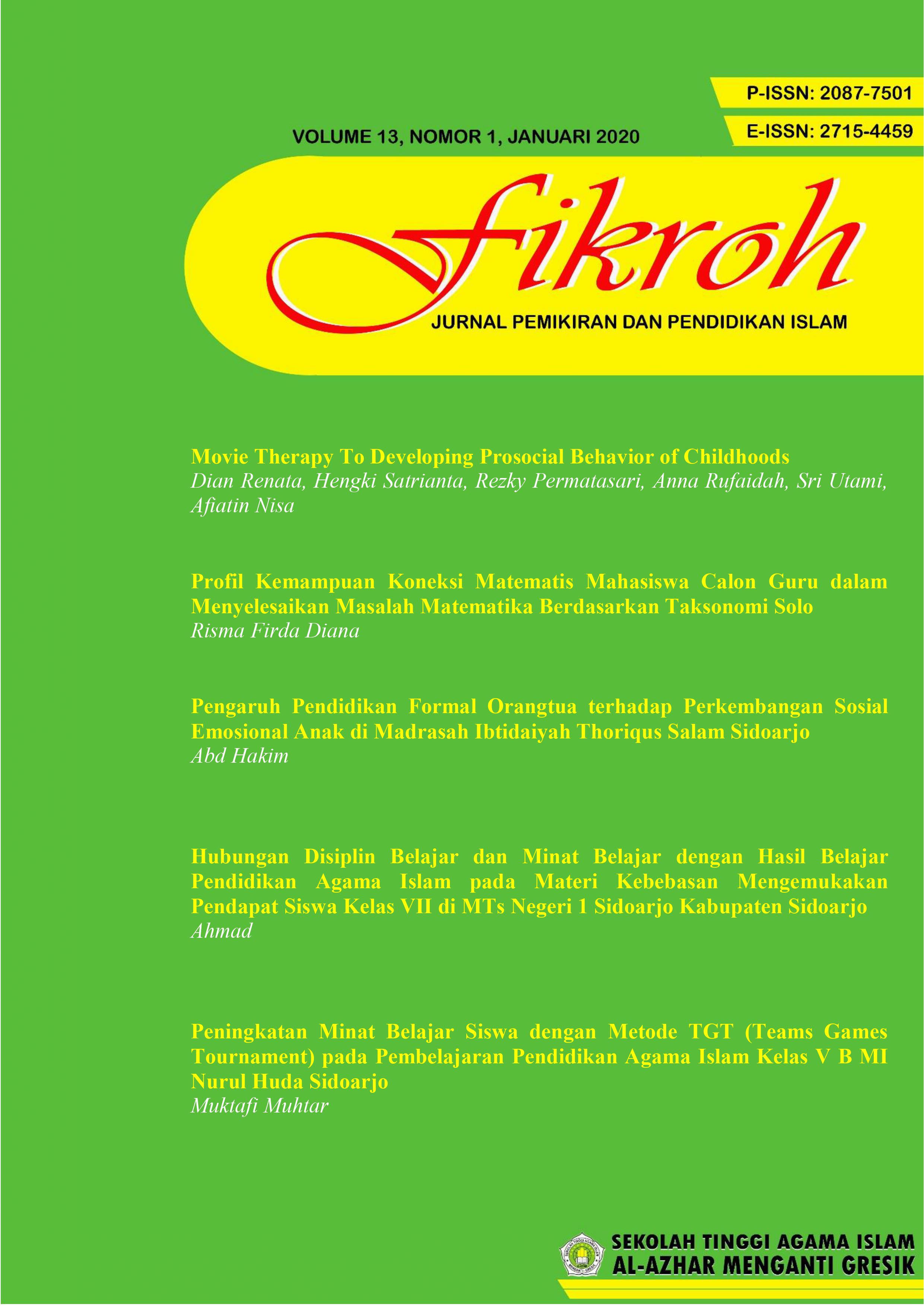
Movie Therapy To Developing Prosocial Behavior of Childhoods
DOI:
https://doi.org/10.37812/fikroh.v13i1.56Keywords:
Movie Therapy, Prosoc9ial BehaviorAbstract
Movie Therapy To Developing Prosocial Behavior Of Childhoods. The phase of human life was beginning from the prenatal period and will end in late adulthood. Childhoods is critical age or golden age. In this phase childs tend to be selfish and far form prosocial behavior. This was need to be given intervention. One of intervention than can given through movie therapy. This article aim to describe whether movie therapy can develop prosocial behavior of childhoods. This research used quantitative research with experiment method. Samples in this research was 17 students. Instrument of this research was used prosocial behavior scale. Data were analyzed by sign test. The result shown that movie therapy was able to develop childhoods prosocial behavior. Implications of this findings in teacher and especially school counselors must to try this method to help childhoods with the lack of prosocial behavior. So, happy watching!
Downloads
References
Andrade, Brendan F, Dillon T Browne, and Rosemary Tannock. Prosocial Skills May Be Necessary for Better Peer Functioning in Children with Symptoms of Disruptive Behavior Disorders. PeerJ 2, no. August 2015 (2014): 116. https://doi.org/10.7717/peerj.487.
Briggs, R.D. The Importance of Social Emotional Development in Early Childhood. Pediatrics for Parent 28 (2012): 1016.
Brownell, Celia A. Early Development of Prosocial Behavior: Current Perspectives. Infancy 18, no. 1 (2013): 19. https://doi.org/10.1111/infa.12004.
Calvert, Sarah L. Media and Early Development. In Blackwell Handbook of Early Childhood Development, edited by Kathleen McCartney and Deborah Phillips, 50830. UK: Blackwell Publishing, 2006. https://doi.org/10.1007/s13398-014-0173-7.2.
Cirelli, Laura K., Kathleen M. Einarson, and Laurel J. Trainor. Interpersonal Synchrony Increases Prosocial Behavior in Infants. Developmental Science 17, no. 6 (2014): 100311. https://doi.org/10.1111/desc.12193.
Coyne, Sarah M., Laura Stockdale, Jennifer Ruh Linder, David A. Nelson, Kevin M. Collier, and Lee W. Essig. Pow! Boom! Kablam! Effects of Viewing Superhero Programs on Aggressive, Prosocial, and Defending Behaviors in Preschool Children. Journal of Abnormal Child Psychology, 2017, 113. https://doi.org/10.1007/s10802-016-0253-6.
Dunfield, Kristen, Valerie A. Kuhlmeier, Laura OConnell, and Elizabeth Kelley. Examining the Diversity of Prosocial Behavior: Helping, Sharing, and Comforting in Infancy. Infancy 16, no. 3 (2011): 22747. https://doi.org/10.1111/j.1532-7078.2010.00041.x.
Flook, Lisa, Simon B. Goldberg, Laura Pinger, and Richard J. Davidson. Promoting Prosocial Behavior and Self-Regulatory Skills in Preschool Children through a Mindfulness-Based Kindness Curriculum. Developmental Psychology 51, no. 1 (2015): 4451. https://doi.org/10.1037/a0038256.
Gentile, Douglas A., Craig A. Anderson, Shintaro Yukawa, Nobuko Ihori, Muniba Saleem, Lim Kam Ming, Akiko Shibuya, et al. The Effects of Prosocial Video Games on Prosocial Behaviors: International Evidence From Correlational, Longitudinal, and Experimental Studies. Personality and Social Psychology Bulletin 35, no. 6 (2009): 75263. https://doi.org/10.1177/0146167209333045.
Gramaglia, Carla, Amalia Jona, Fredrica Imperatori, Eugenio Torre, and Patrizia Zeppegno. Cinema in the Training of Psychiatry Residents: Focus on Helping Relationships. BMC Medical Education 13, no. 1 (2013): 90. https://doi.org/10.1186/1472-6920-13-90.
Greitemeyer, Tobias, and Silvia Osswald. Effects of Prosocial Video Games on Prosocial Behavior. Journal of Personality and Social Psychology 98, no. 2 (2010): 21121. https://doi.org/10.1037/a0016997.
Guinote, Ana, Ioanna Cotzia, Sanpreet Sandhu, and Pramila Siwa. Social Status Modulates Prosocial Behavior and Egalitarianism in Preschool Children and Adults. Proceedings of the National Academy of Sciences 112, no. 3 (2015): 73136. https://doi.org/10.1073/pnas.1414550112.
Kärtner, Joscha, Heidi Keller, and Nandita Chaudhary. Cognitive and Social Influences on Early Prosocial Behavior in Two Sociocultural Contexts. Developmental Psychology 46, no. 4 (2010): 90514. https://doi.org/10.1037/a0019718.
Kim, Ha Gang. Effects of a Cinema Therapy-Based Group Reminiscence Program on Depression and Ego Integrity of Nursing Home Elders. Journal of Korean Academy of Psychiatric and Mental Health Nursing 23, no. 4 (2014): 23341.
Kirschner Sebastian, S., and Michael Tomasello. Joint Music Making Promotes Prosocial Behavior in 4-Year-Old Children. Evolution and Human Behavior 31, no. 5 (2010): 35464. https://doi.org/10.1016/j.evolhumbehav.2010.04.004.
Lampropoulos, Georgios K., Nikolaos Kazantzis, and Frank P. Deane. Psychologists Use of Motion Pictures in Clinical Practice. Professional Psychology: Research and Practice 35, no. 5 (2004): 53541. https://doi.org/10.1037/0735-7028.35.5.535.
Layous, Kristin, S. Katherine Nelson, Eva Oberle, Kimberly A. Schonert-Reichl, and Sonja Lyubomirsky. Kindness Counts: Prompting Prosocial Behavior in Preadolescents Boosts Peer Acceptance and Well-Being. PLoS ONE 7, no. 12 (2012): 79. https://doi.org/10.1371/journal.pone.0051380.
Li, Ya. Nostalgia Promoting Pro-Social Behavior and Its Psychological Mechanism. Open Journal of Social Sciences 3, no. October (2015): 17786.
Molaie, A., and AR Abedin. Effectiveness of Group Movie Therapy (GMT) on Reduction of Grief Experience Intensity in Bereaved Adolescent Girls. Iranian Journal of Psychiatry and Behavioral Sciences 5, no. 1 (2011): 2532. http://206.223.176.35/files/onlineJournals_2506408= molaei.pdf.
Nurjanah, E. Pengaruh Media Film Terhadap Motivasi Belajar Dalam Pembelajaran Pendidikan Kewarganegaraan (PKn). University of Education Indonesia, 2013.
Nurmalitasari, Femmi. Perkembangan Sosial Emosi Pada Anak Usia Prasekolah. Buletin Psikologi, 2015. https://doi.org/10.22146/bpsi.10567.
Plummer, Deborah M. Helping Children to Improve Their Communication Skills: Therapeutic Activities for Teachers and Parents and Therapists. London & Philadelphia: Jessica Kingsley Publishers, 2011. https://doi.org/10.1080/1034912X.2014.934022.
Prayitno, and Erman Amti. Dasar-Dasar Bimbingan Dan Konseling. Edisi Revi. Jakarta: PT. Rineka Cipta, 2013.
Santoso, Singgih. Panduan Lengkap SPSS Versi 20. Edisi Revi. Jakarta: PT. Elex Media Komputindo, 2014.
Santrock, J.W. Child Development. Climate Change 2013 - The Physical Science Basis. 13th ed. New York: McGraw-Hill Companies, Inc., 2010. https://doi.org/10.1017/CBO9781107415324.004.
Schonert-Reichl, Kimberly A., Veronica Smith, Anat Zaidman-Zait, and Clyde Hertzman. Promoting Childrens Prosocial Behaviors in School: Impact of the Roots of Empathy Program on the Social and Emotional Competence of School-Aged Children. School Mental Health 4, no. 1 (2012): 121. https://doi.org/10.1007/s12310-011-9064-7.
Schunk, D.H. Learning Theories An Educational Perspective Teori-Teori Pembelajaran: Perspektif Pendidikan. 6th ed. Yogyakarta: Pustaka Pelajar, 2012.
Shaffer, David R, and K. Kipp. Developmental Psychology: Childhood and Adolescence. 8th ed. Belmont, CA 94002-3098: Wadsworth, 2010.
Sharp, C., J.V. Smith, and A. Cole. Cinematherapy: Metaphorically Promoting Therapeutic Change. Counselling Psychology Quarterly 15, no. 3 (2002): 269 276.
Smithikrai, Chuchai, Nathawat Longthong, and Chatwiboon Peijsel. Effect of Using Movies to Enhance Personal Responsibility of University Students. Asian Social Science 11, no. 5 (2015): 19. https://doi.org/10.5539/ass.v11n5p1.
Strong, Philippa, and George Lotter. Reel Help for Real Life: Film Therapy and Beyond. HTS Teologiese Studies / Theological Studies 71, no. 3 (2015): 18. https://doi.org/10.4102/hts.v71i3.2878.
Suranata, Kadek, and Made Sulastri. Masalah-Masalah Yang Dialami Anak Usia Dini Dan Implikasinya Bagi Pelaksanaan Bimbingan Dan Konseling Di Taman Kanak-Kanak. Jurnal Pendidikan Dan Pengajaran XLIII, no. 11 (2010): 8995.
Suyanto, S. Dasar-Dasar Pendidikan Anak Usia Dini. Yogyakarta: Hikayat Publishing, 2005.
Tasimi, Arber, and Liane Young. Memories of Good Deeds Past: The Reinforcing Power of Prosocial Behavior in Children. Journal of Experimental Child Psychology 147 (2016): 15966. https://doi.org/10.1016/j.jecp.2016.03.001.
Trianto. Film Sebagai Media Belajar. Yogyakarta: Graha Ilmu, 2013.
Tyson, L. E., L.H. Foster, and C. M. Jones. The Process of Cinematherapy As A Therapeutic Intervention. Alabama Counseling Association Journal 26, no. 1 (2000): 35 41.
Wright, Lisa A., and Rebecca B. McCathren. Utilizing Social Stories to Increase Prosocial Behavior and Reduce Problem Behavior in Young Children with Autism. Child Development Research 2012 (2012): 113. https://doi.org/10.1155/2012/357291.
Yang, Heewon, and Youngkhill Lee. The Use of Single-Session Cinematherapy and Aggressive Behavioral Tendencies among Adopted Children A Pilot Study. American Journal of Recreation Therapy, 2005, 110.
Yazici, Esra, Fuat Ulus, Rabia Selvitop, Ahmet Yazici, and Nazan Aydin. Use of Movies for Group Therapy of Psychiatric Inpatients: Theory and Practice. International Journal of Group Psychotherapy 64, no. 2 (2014): 25570.
Yusuf, A.Muri. Metode Penelitian: Kuantitatif, Kualitatif, Dan Penelitian Gabungan. Jakarta: Kencana Prenadamedia Group, 2014.