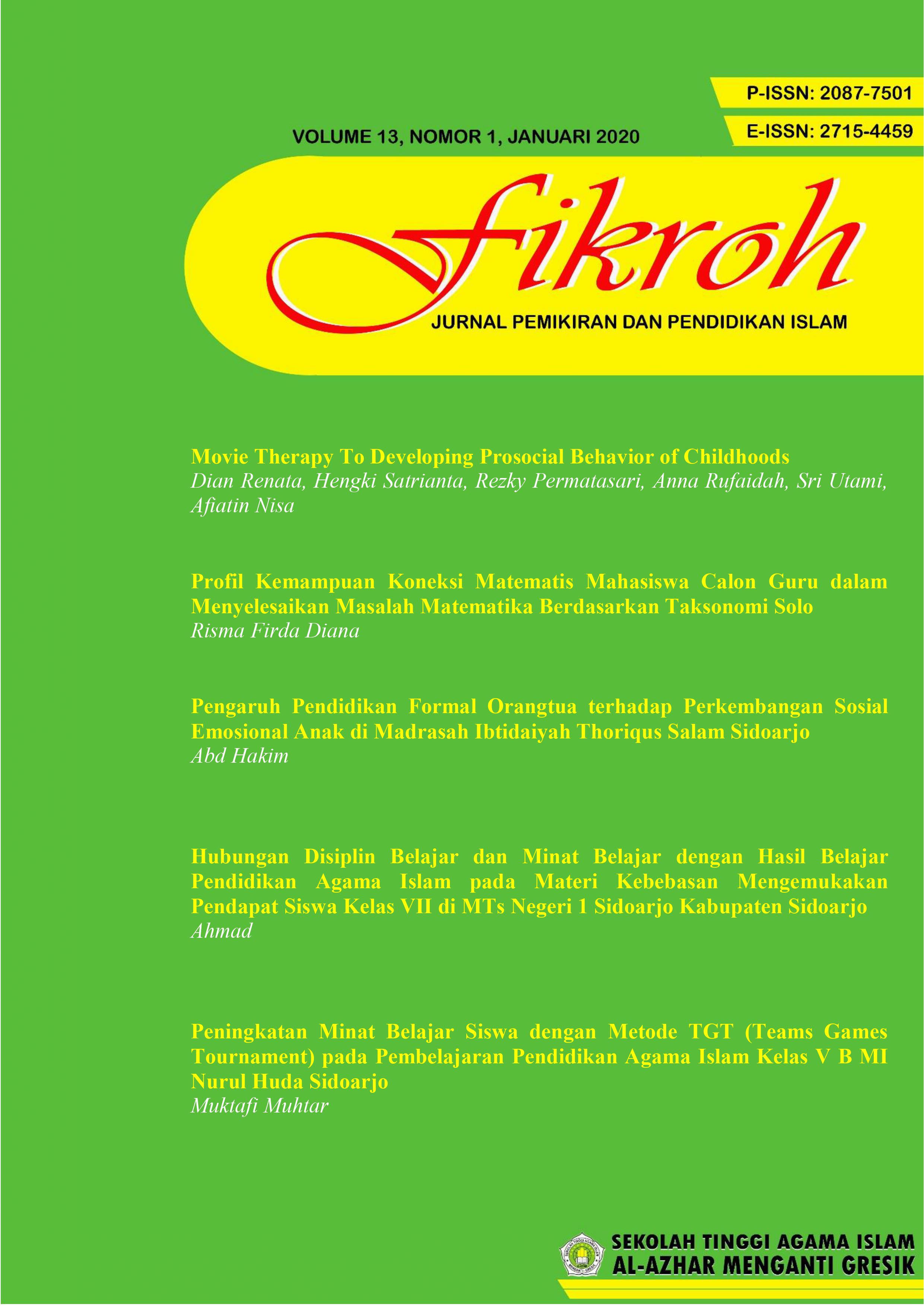
Peningkatan Minat Belajar Siswa dengan Metode TGT (Teams Games Tournament) pada Pembelajaran Pendidikan Agama Islam Kelas V B MI Nurul Huda Sidoarjo
DOI:
https://doi.org/10.37812/fikroh.v13i1.59Keywords:
Interest, TGT method, student activityAbstract
This research is done because the reality of teachers complained about low awareness of students to do independent taska and learning in the classroom is mostly passive students and this affects low interest in learning, especially v b (fifth b) class, from the results of research that teachers only using speech methods that are considered less effective in learning because the students activity is very limited. The purpose of this research is to describe the application of tgt method (teams games tournament) to the fifth class (v) on mathematic lesson. It is able to know the students interest level on mathematic especially for geometry after using tgt (teams games tournament)method. This research uses tgt (teams games tournament) method and classroom action research by kemmis and mc. Taggart. This researchconsist of 2 cycles with fifth b class (v b) as research subject at mi nurul huda sidoarjo. Data collection techniques using observation and questionnaire, with observation sheet of teachers and students to support the researchs instrument. The application of tgt (teams games tournament) method works so well through improvements in each cycle.this is indicated by increased activity of teachers and students i n the learning process. Teacher activity increased from good category in cycle i to be very good in cyle ii. Likewise with students activity increased during the learning process. This is evident from the observation on cycle i categorized well and increased on cycle ii that categorized very good. So, there was an increasing of students interest level on mathematics subject at mi nurul hudasidoarjo after using tgt (teams games tournament) method. This is evidenced by students activeness in following the teaching learning process, and evidenced from the re sult of students questionnaires in learing that categorized very well.
Downloads
References
Hamim, Nur dan Husniyatus Salamah, 2009.Penelitian Tindakan Kelas, LPTK Fakultas Tarbiyah IAIN Surabaya: Revka Petra Media
Herman Hudojo, 2003. Pengembangan Kurikulum dan Pembelajaran Matematika, Malang:UNM
Indriyastuti,2012.Buku paket Pendidikan Agama Islamkelas.Solo:PT Tiga Serangkai Pustaka Mandiri.
Majid, Abdul. 2001. Perencanaan Pembelajaran. Bandung:PT Remaja Rodaskarya
Moh. Uzer Usman, 2001. Menjadi Guru Profesional, Bandung:Remaja Rosda Karya.
Novirawati. 2009. Peningkatan Prestasi Belajar Pendidikan Agama Islamdengan Metode Pembelajaran Kooperatif Model Jigsaw Kelas IV SDN Domas Kecamatan Trowulan Kabupaten Mojokerto. Skripsi tidak diterbitkan. Jurusan S1 PGSD. Universitas Terbuka.
Rafiuddin. 1997. Rancangan Penelitian. makalah disajikan dalam lokakarya tingkat lanjut penelitian kualitaif. Angkasa V tahun 1996/1997. Malang:IKIP.
Sardiman AM, 1988. Interaksi dalam Proses Belajar Mengajar, Jakarta:Rajawali Pers.
Supriyanto, Didik. MODELING: Jurnal Program Studi PGMI 2, no. 2 (September 3, 2015). http://jurnal.stitnualhikmah.ac.id/index.php/modeling/article/view/67.
Sudjana, 1988.Evaluasi Hasil Belajar, Bandung: Pustaka Martiana
Sugiyono, 2008.Metode Penelitian Kuantitatif Kualitatif dan R&D, Bandung: alfabeta
Sumanto, Y.D, 2008. Gemar Matematika.Jakarta:Pusat Perbukuan Departemen Pendidikan Nasional.
Supriyanto, Didik. “Pengaruh Pendekatan Saintifik pada Pembelajaran Seni Budaya dan Prakarya terhadap Capaian Akademis Siswa Kelas IV di MI Salafiyah Syafiiyah II Klinterejo Sooko Mojokerto”. Nazhruna: Jurnal Pendidikan Islam 2, No. 2 (August 11, 2019).
Tim Dosen UNESA, 2009. Model-Model Pembelajaran Inovatif, Surabaya: UNESA University Press
Trianto, M.Pd. 2010. Mendesain Model Pembelajaran Inovatif-Progresif. Jakarta:Kencana Prenada Media Group.