Analysis of the Use of Artificial Intelligence (AI) in Enhancing Elementary School Students’ Motivation to Learn
DOI:
https://doi.org/10.37812/zahra.v7i2.2463Keywords:
Artificial Intelligence; learning motivation; elementary education; educational technology; teacher competence.Abstract
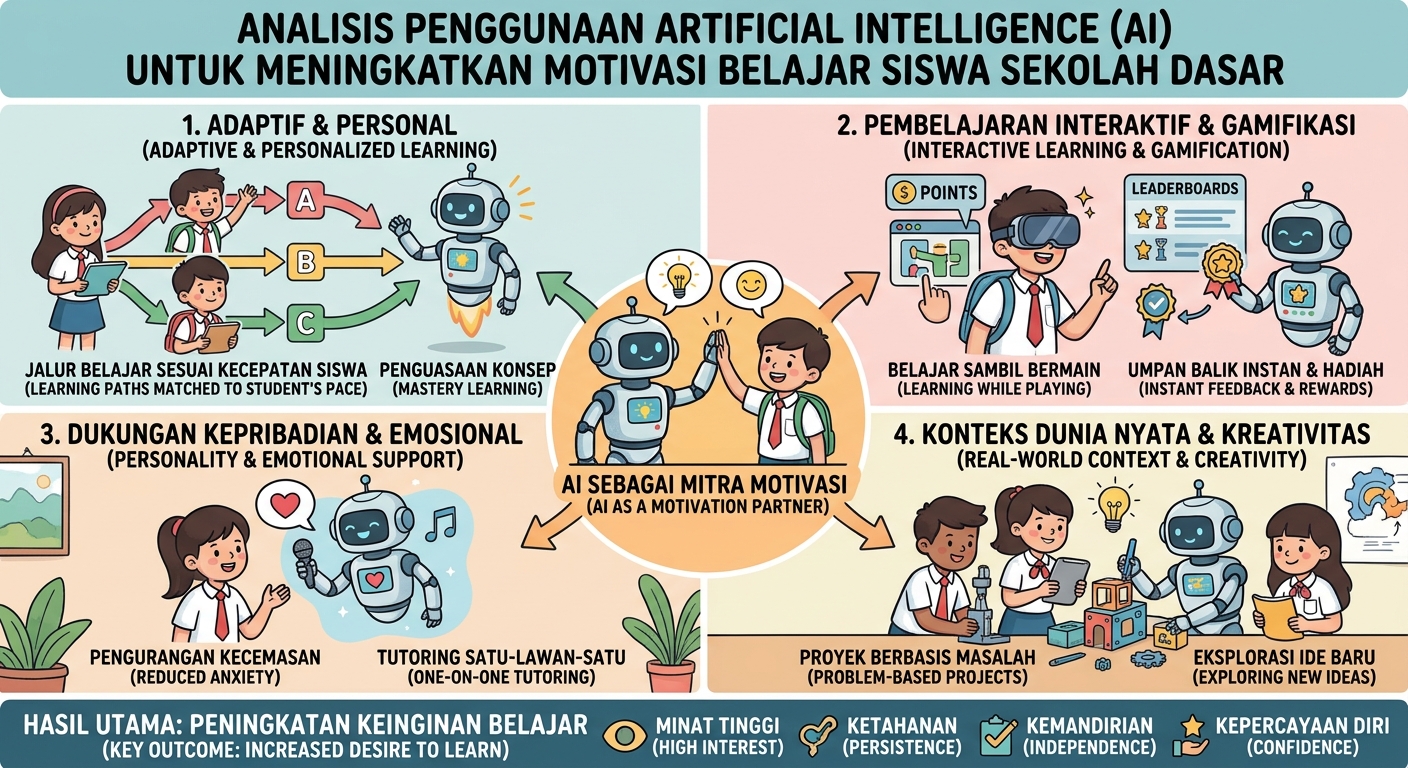
This study aims to analyze the use of Artificial Intelligence (AI) in enhancing elementary school students' learning motivation and to identify the supporting and inhibiting factors influencing its implementation. The study is motivated by students' low learning motivation, as reflected in their limited enthusiasm, participation, and engagement in the learning process. A descriptive qualitative approach was employed at SDIT Yasir Cipondoh, Tangerang City, Indonesia. Data were collected through observations, interviews, documentation, and a literature review, and were analyzed descriptively. The findings indicate that AI supports teachers in preparing instructional activities, particularly in designing learning materials, developing instructional media, preparing assessment questions, and creating more interactive learning experiences. The use of AI also contributes to increased students' interest, concentration, and participation during classroom activities. Nevertheless, its implementation faces several challenges, particularly limited technological facilities, inadequate internet access, and teachers' varying levels of readiness and competence in utilizing AI effectively. This study highlights the potential of AI as an innovative instructional support technology that can enhance students' learning motivation when appropriately, critically, and responsibly integrated into educational practices, while maintaining teachers' central role as the primary facilitators of the learning process.
Downloads
References
Abdurrahman, A. R., Rizki, M. B., & Pradana, R. B. (2025). Pengaruh penggunaan AI terhadap kompetensi dan motivasi belajar mahasiswa. 9(1), 201–210.
Ade, M., Harahap, K., Rinovian, R., & Munandar, H. (2023). Pemanfaatan teknologi artificial intelligence (AI) bagi dosen dalam menghadapi tantangan perguruan tinggi pada era disrupsi. 3, 10566–10576.
Alief, R., & Nurmiati, E. (2022). Penerapan artificial intelligence dan teknologi informasi pada efisiensi manajemen pengetahuan. 13(1), 59–69.
Amriyah, C., Firmansah, D., & Fiteriani, I. (2025). Pemanfaatan artificial intelligence untuk meningkatkan kualitas pembelajaran di madrasah ibtidaiyah: Sebuah kajian literatur. 10(3), 93–111.
Anisa, D. D., & Farhana, H. (2025). Analisis strategi guru dalam meningkatkan motivasi belajar siswa pada pelajaran IPAS kelas V A di SDN Perwira IV Kota Bekasi.
Arly, A., Dwi, N., & Andini, R. (2023). Implementasi penggunaan artificial intelligence dalam proses pembelajaran mahasiswa Ilmu Komunikasi di kelas A, 362–374.
Baharuddin, Sahidin, Kholilah, A., & Yanuar, F. A. (2025). Pendidikan Islam dalam era artificial intelligence: Membangun peradaban berbasis etika dan teknologi di Indonesia. 8, 3782–3791.
Batubara, Y. (2024). Pemanfaatan artificial intelligence (AI) sebagai strategi dakwah: Analisis peluang dan tantangan. 6.
Çayir, A. (2023). A literature review on the effect of artificial intelligence on education. Journal of Human and Social Sciences (JOHASS), 6(2), 276–288.
Conijn, R., Kahr, P., & Snijders, C. (2026). The effects of explanations in automated essay scoring systems on student trust and motivation. 10, 37–53. https://doi.org/10.18608/jla.2023.7801
Diantama, S. (2023). Pemanfaatan artificial intelligence (AI) dalam dunia pendidikan. 1(1), 8–14.
Gocen, A., & Aydemir, F. (2020). Artificial intelligence in education and schools. 12, 1–4. https://doi.org/10.2478/rem-2020-0003
Hanyfah, S., Fernandes, G. R., & Budiarso, I. (2022). Penerapan metode kualitatif deskriptif untuk aplikasi pengolahan data pelanggan, 339–344.
Hapsari, D. D., Ramadhani, G. Y., & Ikramullah, N. I. (2024). Literature review: Pengaruh artificial intelligence (AI) terhadap motivasi belajar peserta didik. 13.
Huang, J., Saleh, S., & Liu, Y. (2021). A review on artificial intelligence in education, 206–217.
Jamilah, E., Purnamasari, A., Ramadan, I., & Warta, W. (2025). Pemanfaatan artificial intelligence (AI) sebagai media pembelajaran interaktif dalam meningkatkan motivasi belajar murid SDN Sawahlega 02 Kabupaten Bandung. 10, 215–222.
Keong, L. M. (2025). AI-personalised learning in higher education: A study on learning outcomes and motivation among university students. IX, 6075–6085. https://doi.org/10.47772/IJRISS
Kisno, Fatmawati, N., Rizkiyani, R., Kurniasih, S., & Ratnasari, E. M. (2023). Pemanfaatan teknologi artificial intelligence (AI) sebagai respons positif mahasiswa PIAUD dalam kreativitas pembelajaran dan transformasi digital. 04(1), 44–56.
Lee, S. J., & Kwon, K. (2024). A systematic review of AI education in K-12 classrooms from 2018 to 2023: Topics, strategies, and learning outcomes. Computers and Education: Artificial Intelligence, 6, 100211. https://doi.org/10.1016/j.caeai.2024.100211
Li, W., Zhang, X., Li, J., Yang, X., Li, D., & Liu, Y. (2024). An explanatory study of factors influencing engagement in AI education at the K-12 level: An extension of the classic TAM model. Scientific Reports, 14, Article 13922. https://doi.org/10.1038/s41598-024-64363-3
Lo, C. K., Hew, K. F., & Jong, M. S.-Y. (2024). The influence of ChatGPT on student engagement: A systematic review and future research agenda. Computers & Education, 219, 105100. https://doi.org/10.1016/j.compedu.2024.105100
Marlin, K., Tantrisna, E., Mardikawati, B., Anggraini, R., & Susilawati, E. (2023). Manfaat dan tantangan penggunaan artificial intelligence (AI) ChatGPT terhadap proses pendidikan etika dan kompetensi. 3, 5192–5201.
Mei, N. Y., Fathammubina, F., Andriani, S., Nurhanipa, Danil, M., & Khairunnas. (2024). Kontroversi dan risiko artificial intelligence dalam pendidikan agama Islam. 01, 90–94.
Moundridou, M., Matzakos, N., & Doukakis, S. (2024). Generative AI tools as educators' assistants: Designing and implementing inquiry-based lesson plans. Computers and Education: Artificial Intelligence, 7, 100277. https://doi.org/10.1016/j.caeai.2024.100277
Nijo, & Wahab. (2024). Menggagas inovasi madrasah ibtidaiyah di era digital perspektif kebutuhan dan harapan pelanggan. 5(09), 3425–3437.
Pasaribu, Y. R. A. (2026). Tantangan penggunaan AI bagi pendidikan Islam. 3(1), 250–263.
Pinem, M. S. U. (2024). Inovasi petugas humas imigrasi Soekarno Hatta berbasis AI dan pengaruhnya terhadap persepsi publik. 9(1), 197–204.
Purnomo, S. A. (2024). Manajemen pendidikan Islam dan AI: Peluang dan tantangan. 6(1), 44–53.
Qutub, S. (2025). Pendidikan karakter: Disrupsi teknologi, sebuah peluang, tantangan, dan solusi di dunia pendidikan. x(x), 57–64.
Raharjo, B. (2023). Teori etika dalam kecerdasan buatan (AI).
Rashmi. (2023). Unlocking the potential of AI in education: Challenges and opportunities. 5(4), 1–11.
Reysha, N., & Nugroho, F. (2025). Pemanfaatan artificial intelligence (AI) dalam pembelajaran bahasa Jawa. 11(3), 3350–3365.
Riska, N., Rosmilawati, I., & Juansah, D. E. (2025). Integrasi teknologi AI dalam pembelajaran adaptif untuk meningkatkan keterampilan abad ke-21 di sekolah dasar.
Rui, Z., & Badarch, T. (2022). Research on applications of artificial intelligence in education. 5(2), 72–79. https://doi.org/10.11648/j.ajcst.20220502.17
Rusmawati, R. D., Bandono, A., & Kurniawan, A. (2024). Pemanfaatan AI dalam pengajaran dan pembelajaran. 8(2), 337–351.
Sari, J. M., & Purwanta, E. (2021). The implementation of artificial intelligence in STEM-based creative learning in the Society 5.0 era. 6(2), 433–440. https://doi.org/10.24042/tadris.v6i2.10135
Shadiqin, S. I., Fuadi, T. M., & Ikramatoun, S. (2023). AI dan agama: Tantangan dan peluang dalam era digital. 4(2), 319–333.
Sunarko, A., Chakiki, I., Zuhriyah, L., Sains, U., & Qur, A.-. (2025). Optimalisasi pembuatan media pembelajaran bahasa Arab berbasis AI melalui platform Quizizz. 5(2), 1334–1344. https://doi.org/10.53866/jimi.v5i5.837
UNESCO. (2023). Guidance for generative AI in education and research. https://unesdoc.unesco.org/ark:/48223/pf0000386693
Wahyu, R., Pertiwi, L., Kulsum, L. U., & Hanifah, I. A. (2024). Evaluating the impact of artificial intelligence-based learning methods on students’ motivation and academic achievement. 2(1), 49–58.
Wang, W., Wang, Y., Chen, J., Wang, X., Zhang, H., Guo, C., & Peng, Y. (2025). The effectiveness of AI-supported personalized feedback on students' learning outcomes and motivation: A meta-analysis. Journal of Educational Computing Research. https://doi.org/10.1177/07356331251410020
Williamson, B., Eynon, R., & Williamson, B. (2020). Historical threads, missing links, and future directions in AI in education. 9884. https://doi.org/10.1080/17439884.2020.1798995
Yassir, M., & Saharuna. (2024). Pengaruh artificial intelligence (AI) terhadap hasil belajar mahasiswa yang dimediasi oleh motivasi belajar dan kreativitas. Jambura Journal of Educational Management, 5, 45–54.
Zahra, C. A. A., Miftachudin, & Muttaqin, M. F. (2026). Implementasi pembelajaran deep learning berbasis keterampilan 4C dalam penguatan karakter siswa. 10(1), 34–43.
Zahren, Yogica, R., & Fitri, R. (2025). Journal of Research on Science Education, 3(1), 25–33.
Zhai, C., & Wibowo, S. (2023). A systematic review on artificial intelligence dialogue systems for enhancing English as foreign language students’ interactional competence in the university. Computers and Education: Artificial Intelligence, 4, 100134. https://doi.org/10.1016/j.caeai.2023.100134
Downloads
Published
Issue
Section
License
Copyright (c) 2026 Nabila Tsuraya, Miftachudin, Fitriana Siregar

This work is licensed under a Creative Commons Attribution-ShareAlike 4.0 International License.