Visual Scaffolding Meets Cooperative Learning: Enhancing Narrative Writing Skills in Islamic Elementary Education
DOI:
https://doi.org/10.37812/zahra.v7i2.2511Keywords:
Narrative Writing Skills; Serial Picture Media; STAD Cooperative Learning; Visual Scaffolding; Islamic Elementary Education.Abstract
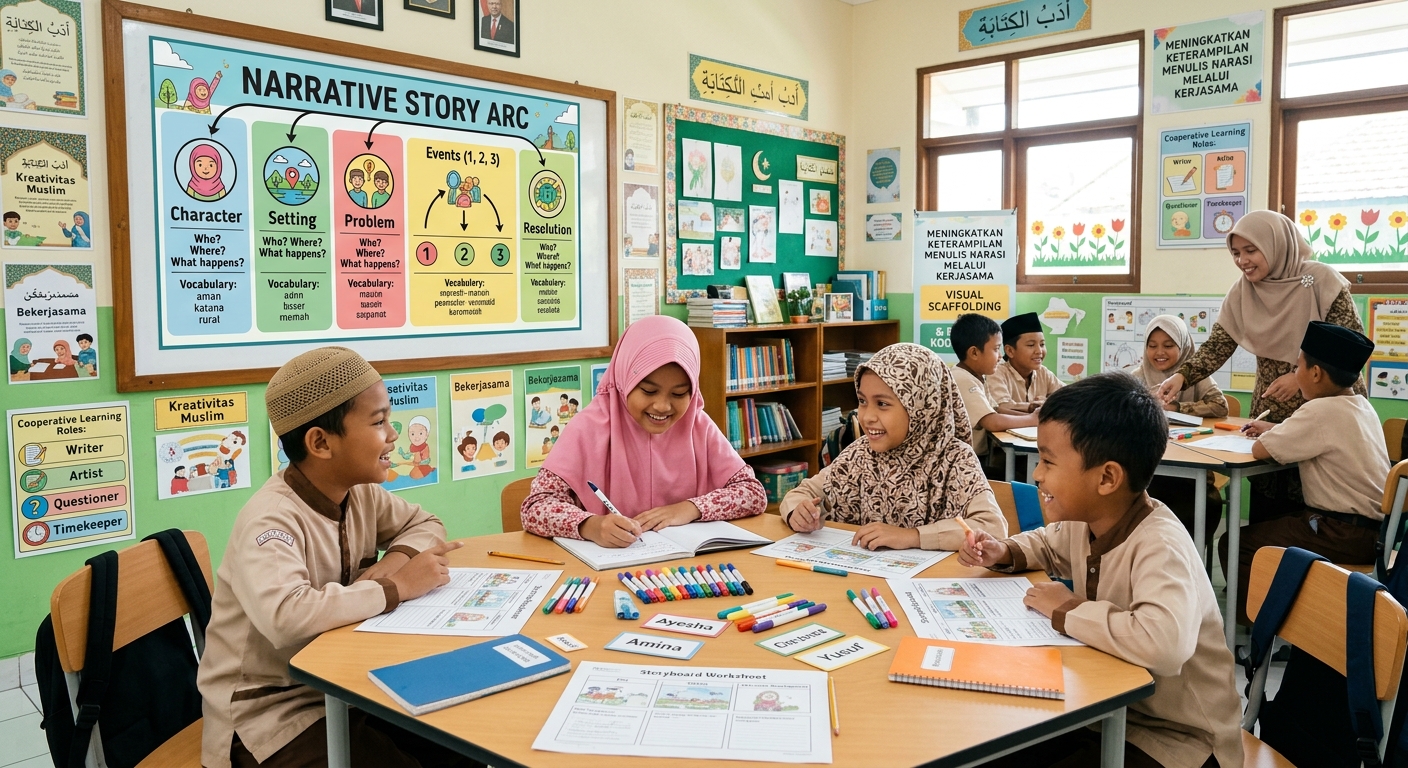
Narrative writing remains a significant challenge for Islamic elementary school students, particularly in generating ideas, organizing events, and constructing coherent texts. This study aims to examine the improvement of students' narrative writing skills through the integration of serial picture media and the Student Teams Achievement Divisions (STAD) cooperative learning model. Employing Classroom Action Research (CAR), the study involved 23 students in an Islamic elementary school in Sidoarjo Regency, Indonesia. The research was conducted across three cycles consisting of planning, action, observation, and reflection. Data were collected through writing tests, classroom observations, and documentation and analyzed using descriptive analysis. The findings revealed a progressive increase in learning mastery from 30% in the pre-cycle to 56% in Cycle I, 78% in Cycle II, and 91% in Cycle III. Students demonstrated improvements in idea generation, narrative organization, and writing coherence through visual stimulation and collaborative interaction. Theoretically, these findings highlight the complementary relationship between visual scaffolding and cooperative learning, suggesting that integrating cognitive and social learning processes can strengthen narrative writing development in Islamic elementary education.
Downloads
References
Akhavian, R., & Behzadan, A. H. (2012). An integrated data collection and analysis framework for remote monitoring and planning of construction operations. Advanced Engineering Informatics, EG-ICE 2011 + SI: Modern Concurrent Engineering, 26(4), 749–761. https://doi.org/10.1016/j.aei.2012.04.004
Artiningsih, A., Riyanto, Y., & Harmanto, H. (2019). Influence of Learning Model Type Cooperative Scramble with Picture Media on Motivation and Students Learning Outcomes of IPS Class 2 SDN 2 Tropodo. International Journal for Educational and Vocational Studies, 1(2), 81–85. https://doi.org/10.29103/ijevs.v1i2.1422
Baffoe-Djan, J. B., & Smith, S. A. (2019). Descriptive statistics in data analysis. In The Routledge Handbook of Research Methods in Applied Linguistics. Routledge.
Belland, B. R., Glazewski, K. D., & Ertmer, P. A. (2009). Inclusion and Problem-Based Learning: Roles of Students in a Mixed-Ability Group. RMLE Online, 32(9), 1–19. https://doi.org/10.1080/19404476.2009.11462062
Benton, S. L., Corkill, A. J., Sharp, J. M., Downey, R. G., & Khramtsova, I. (1995). Knowledge, interest, and narrative writing. Journal of Educational Psychology, 87(1), 66–79. https://doi.org/10.1037/0022-0663.87.1.66
Buaga, G. F., Wuryandani, W., Nugroho, I. A., Kartono, & Alvianto, K. (2024). Discovery Learning Model Assisted by Serial Pictures: It’s Effect on Short Story Writing Ability of PGSD Students. International Journal of Elementary Education, 8(4), 599–608. https://doi.org/10.23887/ijee.v8i4.80867
Burroway, J., Stuckey-French, E., & Stuckey-French, N. (2019). Writing Fiction: A Guide to Narrative Craft. University of Chicago Press.
Chien, S.-C. (2012). Students’ use of writing strategies and their English writing achievements in Taiwan. Asia Pacific Journal of Education, 32(1), 93–112. https://doi.org/10.1080/02188791.2012.655240
Cohen, A. D., & Brooks-Carson, A. (2001). Research on Direct versus Translated Writing: Students’ Strategies and Their Results. The Modern Language Journal, 85(2), 169–188. https://doi.org/10.1111/0026-7902.00103
Cohen, E. G. (1994). Restructuring the Classroom: Conditions for Productive Small Groups. Review of Educational Research, 64(1), 1–35. https://doi.org/10.3102/00346543064001001
Dunn, M. W., & Finley, S. (2010). Children’s Struggles with the Writing Process: Exploring Storytelling, Visual Arts, and Keyboarding to Promote Narrative Story Writing. Multicultural Education, 18(1), 33–42.
Erawati, N. K., Setyawan, I. K. A., & Putra, I. G. P. P. P. (2024). Application of a Cooperative Learning Model of Student Teams Achievement Division Type to Improve Student Achievement in Mathematics Lessons. IJESS International Journal of Education and Social Science, 5(1), 112–117. https://doi.org/10.56371/ijess.v5i1.260
Flower, L., & Hayes, J. R. (1984). Images, Plans, and Prose: The Representation of Meaning in Writing. Written Communication, 1(1), 120–160. https://doi.org/10.1177/0741088384001001006
Flower, L. S., & Hayes, H. R. (1977). Problem-Solving Strategies and the Writing Process. College English, 39(4), 449–461. https://doi.org/10.58680/ce197716437
Grady, M. P. (1998). Qualitative and Action Research: A Practitioner Handbook. Phi Delta Kappa International.
Graham, S., Bollinger, A., Olson, C. B., D’Aoust, C., MacArthur, C., McCutchen, D., & Olinghouse, N. (2012). Teaching Elementary School Students to Be Effective Writers: A Practice Guide. NCEE 2012-4058. What Works Clearinghouse. https://eric.ed.gov/?id=ED533112
Herwin, H., & Pamungkas, B. (2026). Student Teams Achievement Division and Learning Participation Among At-Risk Slow Learners in an Inclusive Third-Grade Classroom. Journal of Innovation and Research in Primary Education, 5(3), 5617–5626. https://doi.org/10.56916/jirpe.v5i3.4153
Hirschberg, P. A., Abrams, E., Bleistein, A., Bua, W., Monache, L. D., Dulong, T. W., Gaynor, J. E., Glahn, B., Hamill, T. M., Hansen, J. A., Hilderbrand, D. C., Hoffman, R. N., Morrow, B. H., Philips, B., Sokich, J., & Stuart, N. (2011). A Weather and Climate Enterprise Strategic Implementation Plan for Generating and Communicating Forecast Uncertainty Information. Bulletin of the American Meteorological Society, 92(12), 1651–1666. https://doi.org/10.1175/BAMS-D-11-00073.1
Hossain, K. I. (2024). Literature-based language learning: Challenges, and opportunities for English learners. Ampersand, 13, 100201. https://doi.org/10.1016/j.amper.2024.100201
Huisman, R., Murphet, J., & Dunn, A. (2006). Narrative and Media. Cambridge University Press.
Jannah, F., & Fahlevi, R. (2018). Strengthening The Pancasila Character Values in Forming The Character of Pancasilais Generation. 77–80. https://doi.org/10.2991/iccite-18.2018.18
Kim, N. W., Bach, B., Im, H., Schriber, S., Gross, M., & Pfister, H. (2018). Visualizing Nonlinear Narratives with Story Curves. IEEE Transactions on Visualization and Computer Graphics, 24(1), 595–604. https://doi.org/10.1109/TVCG.2017.2744118
Kiska, N. D., Haryanto, E., & Indryani, I. (2024). Improving Students’ Collaboration Skills Using the RADEC Learning Model in Elementary School Science Learning. Jurnal Pijar MIPA, 19(2), 240–247. https://doi.org/10.29303/jpm.v19i2.6606
Kurniawan, M. I. (2018). Pancasila as A Basis For Nation’s Character Education. 268–270. https://doi.org/10.2991/icigr-17.2018.64
Kusmawati, W. E., Ghojaji, A. D., Eramansyah, M. G., Putri, R. E., Istianah, S., Asbari, M., & Purwanto, A. (2022). Pancasila Based Character Education to Form Good and Smart Citizens. Journal of Community Service and Engagement, 2(4), 11–18. https://doi.org/10.9999/jocosae.v2i4.62
Lam, R. (2015). Understanding EFL Students’ Development of Self-Regulated Learning in a Process-Oriented Writing Course. TESOL Journal, 6(3), 527–553. https://doi.org/10.1002/tesj.179
Latifah, I., & Safrida, I. (2025). Improving Students’ Language Skills with Punakawan Wayang Media at RA Mansyaul Huda: A Classroom Action Research. Journal of Indonesian Primary School, 2(1), 13–24. https://doi.org/10.62945/jips.v2i1.415
Lee, I. (2002). Teaching coherence to ESL students: A classroom inquiry. Journal of Second Language Writing, 11(2), 135–159. https://doi.org/10.1016/S1060-3743(02)00065-6
Lutfiah, A., Ilham, I., Hudri, M., & Aryani, E. (2025). The Role Creative Writing in Paragraph Writing Class. Scripta : English Department Journal, 12(2), 394–400. https://doi.org/10.37729/scripta.v12i2.7110
Mason, L. H. (2013). Teaching Students Who Struggle With Learning to Think Before, While, and After Reading: Effects of Self-Regulated Strategy Development Instruction. Reading & Writing Quarterly, 29(2), 124–144. https://doi.org/10.1080/10573569.2013.758561
Maula, H. M., & Khalim, A. D. N. (2026). Implementation of the STAD Type Cooperative Learning Model to Improve Students’ Learning Motivation. PrimEdu: Asian Journal of Primary Education, 1(1), 49–61.
Munandar, A., Afifah, J., & Fitri, D. (2024). Cooperative Learning Types of Pictures and Pictures in Increasing Student Learning Activity. Proceeding International Conference on Religion, Science and Education, 3, 515–521.
Myhill, D., & Jones, S. (2007). More Than Just Error Correction: Students’ Perspectives on Their Revision Processes During Writing. Written Communication, 24(4), 323–343. https://doi.org/10.1177/0741088307305976
Nair, S. M., & Sanai, M. (2018). Effects of Utilizing the STAD Method (Cooperative Learning Approach) in Enhancing Students’ Descriptive Writing Skills. International Journal of Education and Practice, 6(4), 239–252.
Paris, S., Salwah, S., & Tayibu, K. N. (2026). The Influence Of The Application Of Cooperative Learning Model Type Student Team Achievement Division (Stad) On The Science Learning Outcomes Of Grade V Students At Sdn Panaikang 1, Panakukang Subdistrict, Makassar City. Jurnal Studi Guru Dan Pembelajaran, 9(2), 1324–1335. https://doi.org/10.30605/jsgp.9.2.2026.9479
Pratama, R. P. (2025). Literature Study of STAD Type Cooperative Learning Model to Improve Student’s Mathematical Communication Skills. JMEA : Journal of Mathematics Education and Application, 4(1), 39–54. https://doi.org/10.30596/jmea.v4i1.20554
Prayitno, B. A., Corebima, A. D., & Susilo, H. (2017). Closing the Science Process Skills Gap Between Students with High and Low Level Academic Achievement. Journal of Baltic Science Education, 16(2), 266–277.
Rahmah, S., & Lubis, A. H. (2024). Problem Posing as a Learning Model to Improve Primary School Students’ Mathematics Learning Outcomes in Gayo Lues. Journal of Indonesian Primary School, 1(4), 93–104. https://doi.org/10.62945/jips.v1i4.409
Rubin, B. (2008). Detracking in Context: How Local Constructions of Ability Complicate Equity-Geared Reform. Teachers College Record, 110(3), 646–699. https://doi.org/10.1177/016146810811000303
Saddler, B., & Graham, S. (2007). The Relationship between Writing Knowledge and Writing Performance among More and Less Skilled Writers. Reading & Writing Quarterly, 23(3), 231–247. https://doi.org/10.1080/10573560701277575
Safiudin, K. (2024). Implementation of the STAD Cooperative Learning Model to Improve Student Understanding. Journal of Student-Centered Learning, 1(2), 97–108. https://doi.org/10.63687/jscl.v1i2.17
Sari, I. P., Rizki, F., & Sormin, R. K. (2023). Implementing STAD To Improve Students’ Ability Of STIKOM Tunas Bangsa In Writing Narrative Text. Journal of Applied Linguistics, 2(2), 7–16. https://doi.org/10.52622/joal.v3i1.115
Saunders, R. P., Evans, M. H., & Joshi, P. (2005). Developing a Process-Evaluation Plan for Assessing Health Promotion Program Implementation: A How-To Guide. Health Promotion Practice, 6(2), 134–147. https://doi.org/10.1177/1524839904273387
Schnotz, W., Böckheler, J., & Grzondziel, H. (1999). Individual and co-operative learning with interactive animated pictures. European Journal of Psychology of Education, 14(2), 245–265. https://doi.org/10.1007/BF03172968
Segel, E., & Heer, J. (2010). Narrative Visualization: Telling Stories with Data. IEEE Transactions on Visualization and Computer Graphics, 16(6), 1139–1148. https://doi.org/10.1109/TVCG.2010.179
Shabrina, A., Hidayah, N., & Jamanuddin, J. (2025). Understanding the Student Team Achievement Division (stad) Model in Maharatul Kitabah Learning: An Effectiveness Analysis Through the Arabicverse Textbook at Fathona Pakjo Palembang Junior High School. Ihya Al-Arabiyah: Jurnal Pendidikan Bahasa Dan Sastra Arab, 11(2), 365–375. https://doi.org/10.30821/ihya.v11i3.26543
Siregar, N., Siregar, H., & Hutahaean, H. (2021). Application of the Picture and Picture Type of Cooperative Learning Model in Improving Student Learning Creativity. JTP - Jurnal Teknologi Pendidikan, 23(1), 23–36. https://doi.org/10.21009/jtp.v23i1.20300
Solichah, M., Supriyono, S., & Masduki, L. R. (2025). Effect of Think Talk Write (TTW) Model with Lagari Media on Primary Students’ Literacy and Communication Skills. EDUTEC : Journal of Education And Technology, 9(1). https://ejournal.ijshs.org/index.php/edu/article/view/1243
Stevens, R. J., & Slavin, R. E. (1995). The Cooperative Elementary School: Effects on Students’ Achievement, Attitudes, and Social Relations. American Educational Research Journal, 32(2), 321–351. https://doi.org/10.3102/00028312032002321
Suastika, I. N., Suartama, I. K., Sanjaya, D. B., & Arta, K. S. (2021). Application of Multicultural-Based Learning Model Syntax of Social Studies Learning. Cypriot Journal of Educational Sciences, 16(4), 1660–1679.
Thompson, C. B. (2009). Descriptive Data Analysis. Air Medical Journal, 28(2), 56–59. https://doi.org/10.1016/j.amj.2008.12.001
Tiantong, M., & Teemuangsai, S. (2013). Student Team Achievement Divisions (STAD) Technique through the Moodle to Enhance Learning Achievement. International Education Studies, 6(4), 85–92.
Utari, U., & Sari, A. V. (2024). The Implementation of the STAD Method to Improve Narrative Writing Skills of Seventh-Grade Students. Jurnal Pendidikan Vokasi Indonesia, 2(02), 42–47. https://doi.org/10.63401/jpvi.v2i02.136
von Koss Torkildsen, J., Morken, F., Helland, W. A., & Helland, T. (2016a). The dynamics of narrative writing in primary grade children: Writing process factors predict story quality. Reading and Writing, 29(3), 529–554. https://doi.org/10.1007/s11145-015-9618-4
von Koss Torkildsen, J., Morken, F., Helland, W. A., & Helland, T. (2016b). The dynamics of narrative writing in primary grade children: Writing process factors predict story quality. Reading and Writing, 29(3), 529–554. https://doi.org/10.1007/s11145-015-9618-4
Webb, N. M., & Mastergeorge, A. (2003a). Promoting effective helping behavior in peer-directed groups. International Journal of Educational Research, 39(1), 73–97. https://doi.org/10.1016/S0883-0355(03)00074-0
Webb, N. M., & Mastergeorge, A. M. (2003b). The Development of Students’ Helping Behavior and Learning in Peer-Directed Small Groups. Cognition and Instruction, 21(4), 361–428. https://doi.org/10.1207/s1532690xci2104_2
Yarrow, F., & Topping, K. J. (2001). Collaborative writing: The effects of metacognitive prompting and structured peer interaction. British Journal of Educational Psychology, 71(2), 261–282. https://doi.org/10.1348/000709901158514
Yuniarto, B., & Yudha, R. P. (2021). Citizenship Education in The Character Building of The Nation. International Journal of Education and Humanities, 1(3), 162–170. https://doi.org/10.58557/ijeh.v1i3.28
Downloads
Published
Issue
Section
License
Copyright (c) 2026 Fitrotin Hasanan

This work is licensed under a Creative Commons Attribution-ShareAlike 4.0 International License.