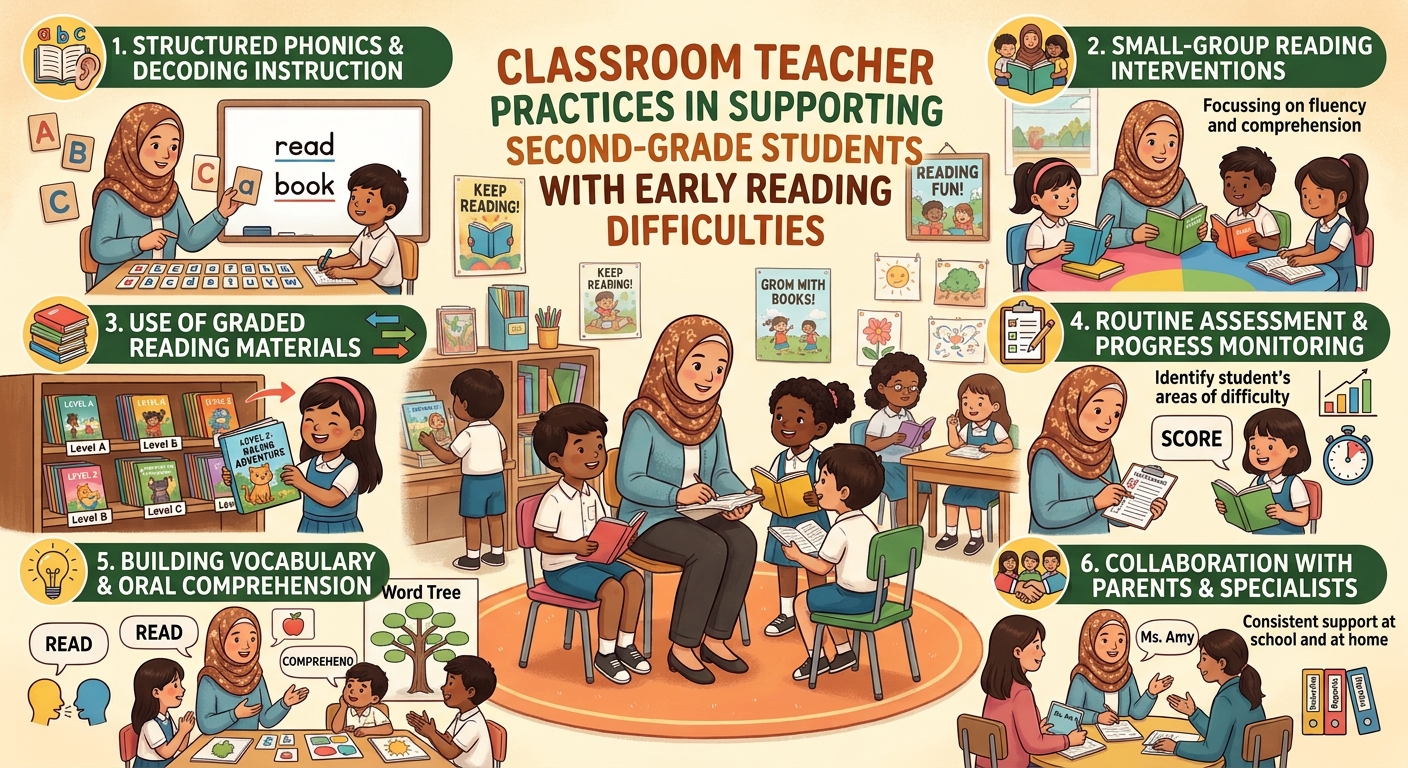
Classroom Teacher Practices In Supporting Second-Grade Students With Early Reading Difficulties
DOI:
https://doi.org/10.37812/zahra.v7i2.2533Keywords:
early reading; Islamic elementary school; reading difficulties; teacher strategiesAbstract
This study aimed to identify the types of early reading difficulties experienced by Grade II students, examine the support strategies implemented by the classroom teacher, explore the factors facilitating and hindering their implementation, and describe students’ documented reading development. A descriptive qualitative approach was employed at MI Muhammadiyah Kedunggudel from 5 January to 28 February 2026. The participants included the Grade II teacher, the head of the madrasah, seven students experiencing reading difficulties, and their parents. Data were collected through observations, semi-structured interviews, a simple reading assessment, and documentation, and were analysed using Miles et al.’s interactive model. The findings revealed that seven of the 24 students (29.17%) required additional support in early reading. Their difficulties included hesitant reading, challenges blending letters into syllables, confusion between similar-looking letters, omission or addition of letters, difficulty reading affixed words, limited comprehension of simple texts, and low confidence when reading. The teacher implemented eight forms of support: individual guidance, syllable-based exercises, letter and word cards, repeated reading, peer tutoring, positive reinforcement, parental collaboration, and periodic evaluation. Individual records indicated varied progress in letter recognition, syllable and word reading, sentence fluency, text comprehension, and student participation. This study highlights the importance of providing early reading support that responds to individual students’ learning needs. However, because the research was limited to one classroom and employed a non-standardized assessment without a comparison group, the documented progress cannot be interpreted as causal evidence of the effectiveness of any particular strategy.
Downloads
References
Aisyah, R. A., & Wibowo, S. E. (2025). Efforts to improve early reading skills and learning motivation through digital flipbook media. Jurnal Prima Edukasia, 13(2), 350–360. https://doi.org/10.21831/jpe.v13i2.75663
Bahrudin, Rochyadi, E., Hufad, A., Susetyo, B., & Taboer, M. A. (2025). Evaluating early reading challenges and their influence on phonological and linguistic awareness in elementary students in DKI Jakarta. Journal of ICSAR, 9(2), 220–234. https://doi.org/10.17977/um005v9i22025p220-234
Castles, A., Rastle, K., & Nation, K. (2018). Ending the reading wars: Reading acquisition from novice to expert. Psychological Science in the Public Interest, 19(1), 5–51. https://doi.org/10.1177/1529100618772271
Daniel, J. (2024). Multicomponent reading intervention: A practitioner's guide. The Reading Teacher, 77(4), 473–484. https://doi.org/10.1002/trtr.2265
Duke, N. K., & Cartwright, K. B. (2021). The science of reading progresses: Communicating advances beyond the Simple View of Reading. Reading Research Quarterly, 56(S1), S25–S44. https://doi.org/10.1002/rrq.411
Ehri, L. C. (2005). Learning to read words: Theory, findings, and issues. Scientific Studies of Reading, 9(2), 167–188. https://doi.org/10.1207/s1532799xssr0902_4
Ehri, L. C. (2020). The science of learning to read words: A case for systematic phonics instruction. Reading Research Quarterly, 55(S1), S45–S60. https://doi.org/10.1002/rrq.334
Ehri, L. C., Nunes, S. R., Stahl, S. A., & Willows, D. M. (2001). Systematic phonics instruction helps students learn to read: Evidence from the National Reading Panel’s meta-analysis. Review of Educational Research, 71(3), 393–447. https://doi.org/10.3102/00346543071003393
Erlin, E., & Saptono, B. (2025). Improving early reading skills in elementary students with the structural analytic synthetic method based on flashcards. Jurnal Prima Edukasia, 13(1), 98–110. https://doi.org/10.21831/jpe.v13i1.80980
Fatonah, N., Damaianti, V. S., & Syaodih, E. (2025). Analysis of early reading difficulties in second grade elementary school students. Jurnal Prima Edukasia, 13(1), 15–26. https://doi.org/10.21831/jpe.v13i1.69965
Foorman, B. R., Beyler, N., Borradaile, K., Coyne, M., Denton, C. A., Dimino, J., Furgeson, J., Hayes, L., Henke, J., Justice, L., Keating, B., Lewis, W., Sattar, S., Streke, A., Wagner, R., & Wissel, S. (2016). Foundational skills to support reading for understanding in kindergarten through 3rd grade. Review of Educational Research, 86(4), 1204–1240. https://doi.org/10.3102/0034654316677029
Fuchs, D., Fuchs, L. S., Mathes, P. G., & Simmons, D. C. (1997). Peer-assisted learning strategies: Making classrooms more responsive to diversity. American Educational Research Journal, 34(1), 174–206. https://doi.org/10.3102/00028312034001174
Fuchs, L. S., Fuchs, D., & Compton, D. L. (2012). Smart RTI: A next-generation approach to multilevel prevention. Exceptional Children, 78(3), 263–279. https://doi.org/10.1177/001440291207800301
Gildorea, P. J. E., Aryanto, S., Suharjuddin, Denatara, E. T., & Awiria. (2025). Effective reading intervention strategies for primary grade students in Indonesia: A systematic review. Cogent Education, 12(1), Article 2482470. https://doi.org/10.1080/2331186X.2025.2482470
Gough, P. B., & Tunmer, W. E. (1986). Decoding, reading, and reading disability. Remedial and Special Education, 7(1), 6–10. https://doi.org/10.1177/074193258600700104
Hattie, J., & Timperley, H. (2007). The power of feedback. Review of Educational Research, 77(1), 81–112. https://doi.org/10.3102/003465430298487
Herlina, H., Mayui, N., Fasli, M., & Aras, N. F. (2024). Identification of beginning reading difficulties in class II primary school students. Indonesian Journal of Educational Development, 5(2), 219–229. https://doi.org/10.59672/ijed.v5i2.3838
Hoover, W. A., & Gough, P. B. (1990). The simple view of reading. Reading and Writing, 2, 127–160. https://doi.org/10.1007/BF00401799
Hulme, C., Shapiro, L. R., & Taylor, J. S. H. (2022). Do family learning phonics courses improve parents’ reading-related skills and ability to support their children’s reading? Journal of Research in Reading, 45(3), 258–276. https://doi.org/10.1111/1467-9817.12377
Mardhotillah, P., Habudin, & Juhji. (2026). Enhancing early reading skills through syllable card media: A quasi-experimental study among first-grade elementary students in Indonesia. Al-Adzka: Jurnal Ilmiah Pendidikan Guru Madrasah Ibtidaiyah, 16(1). https://doi.org/10.18592/aladzkapgmi.v16i1.20241
McArthur, G., et al. (2018). Phonics training for English-speaking poor readers. Cochrane Database of Systematic Reviews, 2018(11), CD009115. https://doi.org/10.1002/14651858.CD009115.pub3
Nichols, W. D., Rupley, W. H., & Rasinski, T. (2008). Fluency in learning to read for meaning: Going beyond repeated readings. Literacy Research and Instruction, 48(1), 1–13. https://doi.org/10.1080/19388070802161906
Perfetti, C., & Stafura, J. (2014). Word knowledge in a theory of reading comprehension. Scientific Studies of Reading, 18(1), 22–37. https://doi.org/10.1080/10888438.2013.827687
Petscher, Y., Cabell, S. Q., Catts, H. W., Compton, D. L., Foorman, B. R., Hart, S. A., Lonigan, C. J., Phillips, B. M., Schatschneider, C., Steacy, L. M., Terry, N. P., & Wagner, R. K. (2020). How the science of reading informs 21st-century education. Reading Research Quarterly, 55(S1), S267–S282. https://doi.org/10.1002/rrq.352
Pratiwi, A. D. (2026). Analisis problematika dan strategi dalam pembelajaran membaca permulaan di sekolah dasar: Systematic literature review. Jurnal Binagogik, 13(2). https://doi.org/10.61290/pgsd.v13i1.1885
Ramadhani, N. R. R., Rizal, R., Aqil, M., & Wilade, S. (2026). Teachers’ intervention strategies for reading difficulties among second-grade students: A qualitative case study in primary education. Journal of Innovation and Research in Primary Education, 5(1), 325–337. https://doi.org/10.56916/jirpe.v5i1.2768
Rasinski, T. V. (2012). Why reading fluency should be hot! The Reading Teacher, 65(8), 516–522. https://doi.org/10.1002/TRTR.01077
Share, D. L. (1995). Phonological recoding and self-teaching: Sine qua non of reading acquisition. Cognition, 55(2), 151–218. https://doi.org/10.1016/0010-0277(94)00645-2
Snowling, M. J., Hulme, C., & Nation, K. (2020). Defining and understanding dyslexia: Past, present and future. Oxford Review of Education, 46(4), 501–513. https://doi.org/10.1080/03054985.2020.1765756
Stanovich, K. E. (1986). Matthew effects in reading: Some consequences of individual differences in the acquisition of literacy. Reading Research Quarterly, 21(4), 360–407. https://doi.org/10.1598/RRQ.21.4.1
Sénéchal, M., & Young, L. (2008). The effect of family literacy interventions on children’s acquisition of reading from kindergarten to grade 3: A meta-analytic review. Review of Educational Research, 78(4), 880–907. https://doi.org/10.3102/0034654308320319
Therrien, W. J. (2004). Fluency and comprehension gains as a result of repeated reading: A meta-analysis. Remedial and Special Education, 25(4), 252–261. https://doi.org/10.1177/07419325040250040801
Therrien, W. J., & Kubina, R. M. (2006). Developing reading fluency with repeated reading. Intervention in School and Clinic, 41(3), 156–160. https://doi.org/10.1177/10534512060410030501
Topping, K. J. (2005). Trends in peer learning. Educational Psychology, 25(6), 631–645. https://doi.org/10.1080/01443410500345172
Triadi, R. B., Syihabuddin, Mulyati, Y., & Damaianti, V. S. (2023). Effect of family and peer tutoring programs on reading comprehension skills. Cypriot Journal of Educational Sciences, 18(1). https://doi.org/10.18844/cjes.v18i1.8211
Downloads
Published
Issue
Section
License
Copyright (c) 2026 Najwa Rahmatillah Bintiriyan, Budi Sunariyanto, Kuni Fatonah, Muh. Zakki Amrulloh, Elyaum Farihah Farihah

This work is licensed under a Creative Commons Attribution-ShareAlike 4.0 International License.