
Transforming Educators’ Paradigm Toward a Pedagogy of Love: Assisting the Implementation of Panca Cinta at LPI Al-Azhar Menganti Gresik
DOI:
https://doi.org/10.37812/pudak.v4i1.2487Keywords:
Love-Based Curriculum; Panca Cinta; Pedagogy of Love; Nomos to Eros; Ecotheology; School Climate; Restorative Discipline; Community Engagement.Abstract
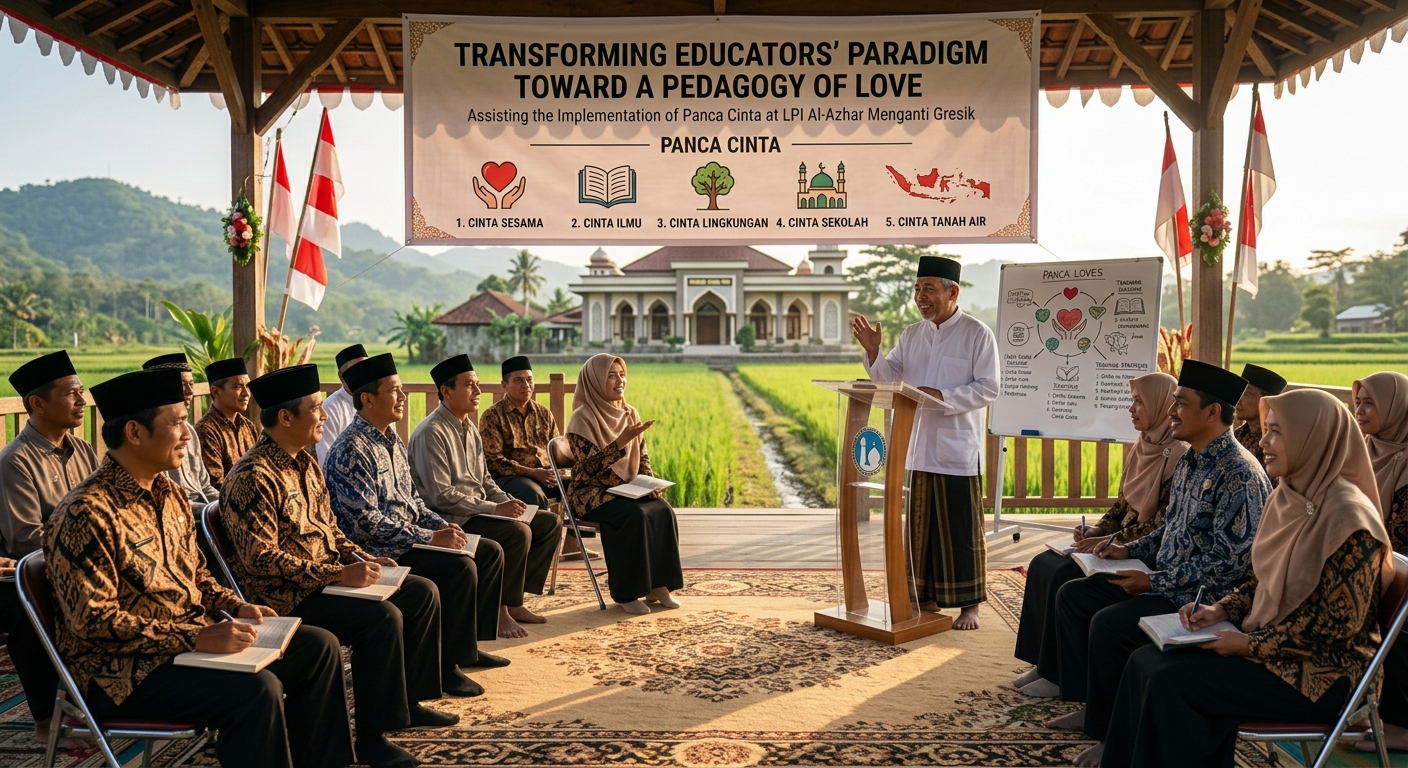
This community engagement (Pengabdian kepada Masyarakat / PkM) initiative addresses the structural crisis of fear-based discipline, punitive legalism (Nomos), and pervasive school violence across basic and secondary Islamic educational institutions. In collaboration with Lembaga Pendidikan Islam (LPI) Al-Azhar Menganti Gresik, an integrated multi-tier complex spanning early childhood (RA) to senior secondary levels (MI, MTs, MA, SMA, SMK) and non-teaching personnel (N = 209), this program assisted the systemic execution of the Love-Based Curriculum (Kurikulum Berbasis Cinta / KBC) through the Panca Cinta (Five Loves) framework. Utilizing an Asset-Based Community Development (ABCD) model intertwined with Participatory Action Research (PAR), the intervention unfolded across five stages: (1) baseline psychometric diagnostic mapping, (2) transformative capacity-building workshops deconstructing four paradigm shifts, (3) qualitative self-mirroring and pedagogical ‘emigration’ (Hijrah Paradigma), (4) contextual grassroots action prototyping, and (5) strategic plenary alignment. Baseline psychometric assessments revealed a profound theological deficit, wherein Love for God recorded the lowest institutional mean (16.03 out of 25.00), accompanied by a pronounced empirical decoupling between ritual piety and ecological praxis (r = 0.218, p = 0.001). Qualitative narrative audits demonstrated a decisive pedagogical migration away from punitive coercion and public humiliation toward restorative care ('Connection Before Correction') and holistic emotional containment. Grassroots innovations successfully institutionalized peer-support networks ('Teman Penjaga') and plastic-reduction mandates. Crucially, the Strategic Plenary Assembly institutionalized hierarchical job descriptions, empowered an autonomous Quality Assurance Institute (LPM) utilizing the Madrasah Love Index, and established an academic partnership with higher education (ISTAZ) to co-author an applied Environmental Jurisprudence (Fiqih Lingkungan) module. This study demonstrates that sustainable love-based pedagogical reform requires synchronizing internal spiritual renewal with robust structural governance.
Downloads
Downloads
Published
Issue
Section
License
Copyright (c) 2025 PUDAK: Local Wisdom Community Journal

This work is licensed under a Creative Commons Attribution-ShareAlike 4.0 International License.


