
Integrating Islamic Values into Digital Literacy and Online Safety Education: A School-Based Intervention for Primary School Students
DOI:
https://doi.org/10.37812/fatawa.v6i2.2522Keywords:
Digital Literacy; Online Safety; Digital Citizenship; Primary Education; Educational Intervention.Abstract
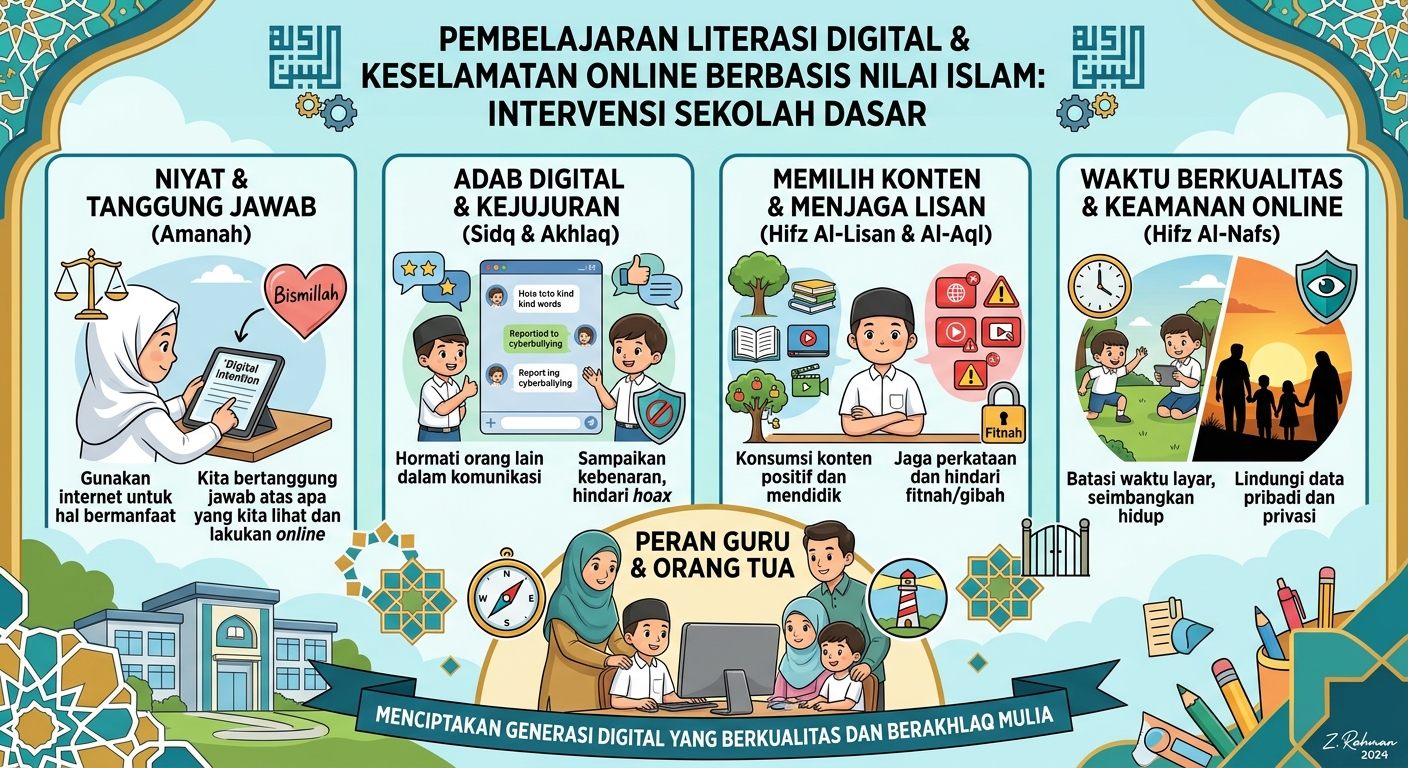
Digital transformation has increased children's access to information and learning while exposing them to misinformation, privacy violations, inappropriate content, and cyberbullying. These challenges underscore the need for digital literacy education integrating technological competencies with Islamic ethical values. This community engagement program aims to strengthen students' digital literacy and online safety awareness through the Gerakan Anak Cerdas Digital (Smart Digital Children Movement) at SDN 02 Padangjaya. Employing a participatory educational approach, the program delivers a 60-minute training session integrating digital safety principles with Islamic values, including tabayyun (information verification), amanah (trustworthiness), adab (ethical communication), and ukhuwah (solidarity). Learning activities comprise interactive instruction, contextual discussions, question-and-answer sessions, and educational quizzes. Evaluation involves comprehension assessments and observations of student participation. The program is expected to enhance students' understanding of digital risks, responsible internet use, personal data protection, and ethical online interactions. Conceptually, this initiative introduces an integrative framework connecting digital literacy with Islamic character education in primary schools. Practically, it offers a contextual model for promoting safe and responsible digital behavior through collaborative engagement among schools, families, and communities, contributing to the development of ethically grounded digital citizenship among young learners.
References
Buckingham, D. (2007). Digital media literacies: Rethinking media education in the age of the internet. Research in Comparative and International Education, 2(1), 43–55. https://doi.org/10.2304/rcie.2007.2.1.43
Boulton, M. J., Boulton, L., Camerone, E., Down, J., Hughes, J., Kirkbride, C., Kirkham, R., Macaulay, P., & Sanders, J. (2016). Enhancing primary school children's knowledge of online safety and risks with the CATZ cooperative cross-age teaching intervention: Results from a pilot study. Cyberpsychology, Behavior, and Social Networking, 19(10), 609–614. https://doi.org/10.1089/cyber.2016.0046
Choi, M. (2016). A concept analysis of digital citizenship for democratic citizenship education in the internet age. Theory & Research in Social Education, 44(4), 565–607. https://doi.org/10.1080/00933104.2016.1210549
Durlak, J. A., Weissberg, R. P., Dymnicki, A. B., Taylor, R. D., & Schellinger, K. B. (2011). The impact of enhancing students’ social and emotional learning: A meta-analysis of school-based universal interventions. Child Development, 82(1), 405–432. https://doi.org/10.1111/j.1467-8624.2010.01564.x
Eshet-Alkalai, Y. (2004). Digital literacy: A conceptual framework for survival skills in the digital era. Journal of Educational Multimedia and Hypermedia, 13(1), 93–106.
Freeman, S., Eddy, S. L., McDonough, M., Smith, M. K., Okoroafor, N., Jordt, H., & Wenderoth, M. P. (2014). Active learning increases student performance in science, engineering, and mathematics. Proceedings of the National Academy of Sciences, 111(23), 8410–8415. https://doi.org/10.1073/pnas.1319030111
Gaffney, H., Farrington, D. P., & Ttofi, M. M. (2019). Examining the effectiveness of school-bullying intervention programs globally: A meta-analysis. International Journal of Bullying Prevention, 1, 14–31. https://doi.org/10.1007/s42380-019-0007-4
Hargittai, E. (2010). Digital na(t)ives? Variation in internet skills and uses among members of the “net generation.” Sociological Inquiry, 80(1), 92–113. https://doi.org/10.1111/j.1475-682X.2009.00317.x
Hobbs, R. (2010). Digital and media literacy: A plan of action. The Aspen Institute. https://www.aspeninstitute.org/publications/digital-media-literacy-plan-action-2/
Jones, L. M., & Mitchell, K. J. (2016). Defining and measuring youth digital citizenship. New Media & Society, 18(9), 2063–2079. https://doi.org/10.1177/1461444815577797
Jones, L. M., Mitchell, K. J., & Beseler, C. L. (2024). The impact of youth digital citizenship education: Insights from a cluster randomized controlled trial outcome evaluation of the Be Internet Awesome (BIA) curriculum. Contemporary School Psychology, 28, 509–523. https://doi.org/10.1007/s40688-023-00465-5
Kolb, D. A. (1984). Experiential learning: Experience as the source of learning and development. Prentice Hall.
Kowalski, R. M., Giumetti, G. W., Schroeder, A. N., & Lattanner, M. R. (2014). Bullying in the digital age: A critical review and meta-analysis of cyberbullying research among youth. Psychological Bulletin, 140(4), 1073–1137. https://doi.org/10.1037/a0035618
Livingstone, S., & Helsper, E. J. (2008). Parental mediation of children’s internet use. Journal of Broadcasting & Electronic Media, 52(4), 581–599. https://doi.org/10.1080/08838150802437396
Livingstone, S., & Smith, P. K. (2014). Annual research review: Harms experienced by child users of online and mobile technologies: The nature, prevalence and management of sexual and aggressive risks in the digital age. Journal of Child Psychology and Psychiatry, 55(6), 635–654. https://doi.org/10.1111/jcpp.12197
Mayer, R. E. (2009). Multimedia learning (2nd ed.). Cambridge University Press.
Mihailidis, P., & Thevenin, B. (2013). Media literacy as a core competency for engaged citizenship in participatory democracy. American Behavioral Scientist, 57(11), 1611–1622. https://doi.org/10.1177/0002764213489015
Mishna, F., Saini, M., & Solomon, S. (2009). Ongoing and online: Children and youth’s perceptions of cyber bullying. Children and Youth Services Review, 31(12), 1222–1228. https://doi.org/10.1016/j.childyouth.2009.05.004
Ng, W. (2012). Can we teach digital natives digital literacy? Computers & Education, 59(3), 1065–1078. https://doi.org/10.1016/j.compedu.2012.04.016
Patchin, J. W., & Hinduja, S. (2015). Measuring cyberbullying: Implications for research. Aggression and Violent Behavior, 23, 69–74. https://doi.org/10.1016/j.avb.2015.05.013
Ribble, M. (2015). Digital citizenship in schools: Nine elements all students should know (3rd ed.). International Society for Technology in Education.
Smahel, D., Machackova, H., Mascheroni, G., Dedkova, L., Staksrud, E., Ólafsson, K., Livingstone, S., & Hasebrink, U. (2020). EU Kids Online 2020: Survey results from 19 countries. EU Kids Online. https://doi.org/10.21953/lse.47fdeqj01ofo
Tanrikulu, I. (2018). Cyberbullying prevention and intervention programs in schools: A systematic review. School Psychology International, 39(1), 74–91. https://doi.org/10.1177/0143034317745721
UNESCO Institute for Statistics. (2018). A global framework of reference on digital literacy skills for indicator 4.4.2. UNESCO Institute for Statistics.
UNICEF. (2017). The state of the world’s children 2017: Children in a digital world. https://www.unicef.org/reports/state-worlds-children-2017
Downloads
Published
Issue
Section
License
Copyright (c) 2026 Jauharotul Mufidah, Zahid Salmani, Imam Kharits Najibulloh, Bahtiar Zulham

This work is licensed under a Creative Commons Attribution-ShareAlike 4.0 International License.